Cross-Border Payments in 2026: Rails, Costs and Why the G20 Targets Are Slipping
Explainer
- Topic: Why sending money across borders is still slow and costly, and what is being done about it
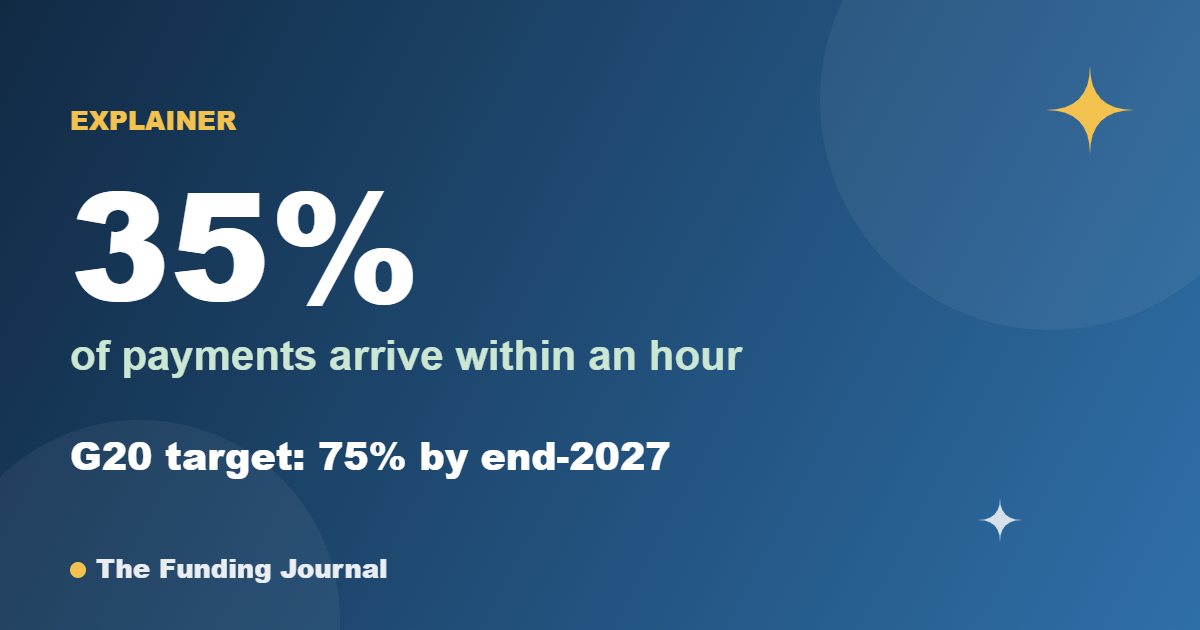
- The G20 targets: Retail average cost of no more than 1% with no corridor above 3%, and 75% of payments credited within an hour, by end-2027
- Where it stands: About 35% of payments were credited within one hour in 2025, according to the FSB’s latest progress report
- Takeaway: Compare total landed cost and delivery time, not the headline fee
Sending money across a border remains slower and more expensive than sending it across town. Several chains of banks, different operating hours, currency conversion and compliance checks all add time and cost. In 2020 the G20 set targets to fix this by the end of 2027. This explainer shows what those targets are, how far the world has come and what businesses can do in the meantime.
Why cross-border payments are hard
- Long chains of intermediaries. A payment often passes through several banks, each adding fees and delay.
- Different time zones and operating hours, so a payment can wait for a bank to open.
- Compliance checks. Sanctions and anti-money-laundering screening apply at several points.
- Currency conversion, often with a margin that is not shown as a fee.
- Inconsistent data and tracking, which makes payments hard to trace or reconcile.
The G20 targets
The Financial Stability Board published the quantitative targets in 2021. Most fall due at the end of 2027.
| Area | Target |
|---|---|
| Retail cost | Global average cost of no more than 1%, with no corridor above 3% (end-2027) |
| Remittance cost | Global average cost of sending $200 of no more than 3%, with no corridor above 5% (2030) |
| Speed | 75% of payments credited within one hour, and the rest within one business day (end-2027) |
| Access | Every end user has at least one option to send or receive cross-border electronic payments; more than 90% of individuals have access to electronic remittances (end-2027) |
| Transparency | Total cost, expected delivery time and tracking information available to payers and recipients (end-2027) |
Where progress stands
The FSB’s October 2025 progress report marked five years since the roadmap began. It found that most international policy work was complete but that improvements for end users were limited, and commentators summarising it judged that the global targets are unlikely to be met on time.
- Speed: 35.4% of payments were completed within one hour in 2025, up 1.9 percentage points from the year before, against a target of 75%, according to a summary by The Paypers of the FSB data.
- Cost: the same summary reports business-to-person payments at about 1.9% on average and person-to-person transfers at about 2.6% to send $1,000, unchanged from 2023.
- Remittances: in the FSB’s 2024 data, the average cost of sending $200 was 6.4%, 0.1 percentage points higher than in 2023, and sending $500 cost 4.3%, unchanged. The 2030 target is 3%.
What is changing
- Linking domestic instant-payment systems. One example in the FSB’s work is the PromptPay–PayNow link between Thailand and Singapore, which aims to meet the G20 objectives in that corridor.
- Better data and messaging standards, so payments can be checked and reconciled faster.
- New entrants and local payout networks that avoid some intermediaries.
- Digital-asset rails such as stablecoins, which raise their own regulatory questions. See our explainer on stablecoins for businesses.
What businesses can do now
- Compare total landed cost, meaning the fee plus the currency margin versus the mid-market rate.
- Ask for delivery time and tracking in writing before you choose a provider.
- Pay locally where you can, for example by holding local accounts or using local payout partners.
- Batch and schedule payments to cut per-transaction cost and avoid cut-off times.
- Capture data for reconciliation, such as references and tracking numbers.
- Keep a fallback provider for corridors where your main provider is slow or restricted.
A worked example: the real cost of a $5,000 payment (illustrative)
The providers and prices below are invented. The point is how a low headline fee can hide a costly currency margin.
| Provider | Visible fee | Currency margin | Total cost on $5,000 | Cost as a share |
|---|---|---|---|---|
| A | $15 | 1.5% ($75) | $90 | 1.8% |
| B | $0 | 2.5% ($125) | $125 | 2.5% |
| C | $25 | 0.5% ($25) | $50 | 1.0% |
Provider B advertises “no fees” yet costs the most. Provider C looks expensive on the fee line but is cheapest overall. Always compare the rate you receive against the mid-market rate on the same day.
The main routes for sending money abroad
| Route | How it works | Strengths | Limits |
|---|---|---|---|
| Bank wire through correspondent banks | Your bank passes the payment through a chain of banks | Wide reach | Several fees, slower, harder to track |
| Local payout by a provider | The provider holds accounts in several countries and pays out locally | Often faster and cheaper | Coverage depends on the provider |
| Card networks | Payments move over card rails | Familiar and fast for consumers | Fees and limits suit small payments |
| Linked instant-payment systems | Two countries connect their domestic systems, as with PromptPay and PayNow | Very fast and low-cost where available | Only for linked corridors |
| Stablecoin-based transfers | Value moves on a blockchain | Available all hours | Regulatory and conversion questions; see our stablecoin explainer |
How to choose a provider
- List your corridors and volumes. The best provider for one corridor may not be the best for another.
- Request an all-in quote that includes fees, the exchange rate and delivery time.
- Check tracking and support. Can you see where a payment is and who to call?
- Review licensing and safeguarding of customer funds in your markets.
- Ask about limits and screening. Sanctions checks can delay payments, so understand how exceptions are handled.
- Test with a small payment before committing a large volume.
- Keep a second provider for contingency.
Compliance and data
- Screening for sanctions and money laundering can add time, especially if payment details are incomplete.
- Clear references and accurate recipient details reduce delays and returns.
- Keep records of invoices and purposes of payment, because providers or banks may ask.
- Reconciliation is easier when providers return tracking numbers and final amounts.
What to watch as 2027 approaches
- The FSB’s next assessment against the end-2027 targets.
- New links between national instant-payment systems.
- Rules on cost and delivery-time transparency for payers and recipients.
- Whether major banks pass progress through to customers.
Frequently asked questions
Why is sending $200 home more expensive than sending $5,000 to a supplier?
The FSB’s data show higher average costs for smaller remittances: in 2024, about 6.4% for $200 and 4.3% for $500. Fixed fees weigh more on small amounts.
What is the mid-market rate?
The rate between the buy and sell prices of two currencies in the wholesale market. Providers add a margin to it.
Are the G20 targets legally binding?
No. They are international goals set by the G20 and tracked by the Financial Stability Board, so progress depends on banks, providers and national authorities.
The Funding Journal view
The gap between policy progress and customer experience is the main story. The rules and standards are mostly in place, but the savings only reach users when banks and payment providers change their products. For businesses, the practical advantage still belongs to those who measure the real cost and speed of each corridor and switch providers when the numbers change.
Sources and further reading
- FSB: G20 targets for enhancing cross-border payments
- FSB: Consolidated progress report (October 2025)
- FSB: Annual progress report on meeting the targets (2024 data)
- The Paypers: Understanding the G20 cross-border payments targets
This article is general information, not financial, legal or tax advice. See our disclaimer. Facts last checked October 26, 2026; rules, prices and companies change, so confirm current terms before you act.
Published by The Funding Journal Editorial. Practical, sourced writing on fintech, crowdfunding, investment platforms, SaaS and AI, and the stories of founders who raised capital.