Seven Fraud Controls Every Investment or Lending Platform Needs
Checklist
- Topic: Practical fraud controls for investment, crowdfunding and lending platforms
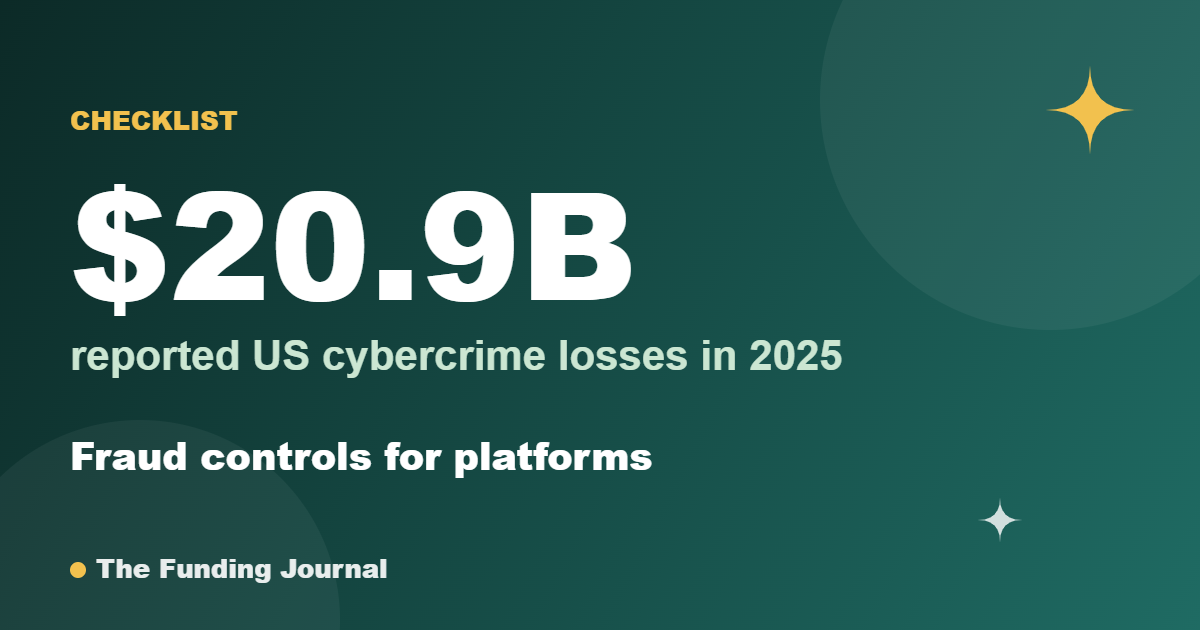
- The data: The FBI’s IC3 received 1,008,597 complaints in 2025 with $20.877 billion in reported losses, up 26% from 2024. Investment fraud was the largest category at about $8.6 billion
- Crypto link: Crypto-related losses were about $11.37 billion, and crypto investment fraud alone about $7.2 billion
- Takeaway: Combine strong identity checks, monitoring and well-timed friction, then learn from every case
Fraud is one of the biggest risks any platform that handles other people’s money will face. The FBI’s Internet Crime Complaint Center reported record losses for 2025, and investment fraud was the largest single category. This checklist sets out seven controls that platforms can use to protect investors, borrowers and themselves.
What the data shows
- Scale. IC3 received 1,008,597 complaints in 2025, with $20.877 billion in reported losses, up about 26% from $16.6 billion in 2024, according to coverage of the report and the ASIS summary.
- Investment fraud leads. It accounted for about $8.65 billion in reported losses, ahead of business email compromise and tech-support scams.
- Cryptocurrency features heavily. Losses linked to crypto reached about $11.37 billion, up 22%. Sumsub’s summary puts crypto investment fraud at roughly $7.2 billion.
- AI is appearing. The FBI report for the first time included a section on AI, with 22,364 complaints and about $893 million in related losses, and investment complaints with an AI link topped $632 million.
- Recovery scams add to the harm. More than 10,500 complaints, with an estimated $1.4 billion in losses, according to the ASIS summary.
These are US figures and only count what victims reported, but the patterns apply to platforms everywhere.
Seven controls
| Control | What it does | Example |
|---|---|---|
| 1. Strong identity verification | Confirms who is opening the account and re-checks on risk events | Document and liveness checks, with re-verification when a user changes bank details |
| 2. Device and behaviour signals | Spots accounts that act unusually | A new device, a new payee and a large withdrawal in the same session |
| 3. Payee and account verification | Reduces misdirected and mule payments | Checking that the account name matches the user before the first payout |
| 4. Transaction monitoring | Flags unusual money movement | Rules first, models second, with tighter limits on new accounts |
| 5. Friction at risky moments | Gives a person time to think and the platform time to check | Payout holds, step-up authentication and a plain-language scam warning before large transfers |
| 6. Issuer and borrower due diligence | Stops fake or duplicate deals | Document authenticity checks, beneficial ownership checks and duplicate-invoice detection |
| 7. Case management and reporting | Turns every incident into learning | Audit trail, suspicious-activity reporting, staff training and a process to help victims |
Scam patterns to train for
- Long-con investment scams that start on social media, messaging apps or dating apps, then move the victim to a fake platform showing fake profits.
- Recovery scams, where a fraudster claims to help victims get their money back for a fee.
- Pressure on older customers, who reported the largest crypto losses in the IC3 data.
- Mule accounts, where criminals use real customers’ accounts to move money.
- Fake issuers and duplicate invoices on lending and crowdfunding platforms.
Measuring what works
- Share of accounts reviewed that were genuine (false-positive rate).
- Time from alert to decision.
- Losses prevented compared with losses paid.
- Number of repeat fraud patterns, which shows whether lessons are being applied.
- Staff completion of fraud and scam training.
Controls by customer stage
| Stage | Main risk | Useful controls |
|---|---|---|
| Onboarding | Fake or stolen identities | Document and liveness checks, sanctions screening and device checks |
| Funding the account | Stolen cards, mule accounts | Payee verification, limits for new accounts and monitoring of source of funds |
| Investing or borrowing | Fake issuers, duplicate invoices, scams | Issuer due diligence, document checks and warnings about unrealistic returns |
| Withdrawal or payout | Account takeover, coerced transfers | Step-up authentication, payout holds on new details and manual review of unusual requests |
| After an incident | Repeat attacks, victim harm | Case review, rule updates, victim support and reporting |
A response playbook
- Detect. An alert or a customer report flags something unusual.
- Contain. Pause the payment or lock the account while you check.
- Verify. Contact the customer through a trusted channel, not the one the scammer may control.
- Decide. Release, reverse or escalate, and record the reason.
- Report. File suspicious-activity reports where required and notify law enforcement when appropriate.
- Support. Give the customer clear next steps and resources.
- Learn. Update rules, training and warnings with what you found.
Warning signs that a customer is being scammed
- They say someone they met online told them to move money or buy crypto.
- They are rushed, or have been told not to tell the bank or platform.
- The destination is new, unusual or tied to a platform you cannot verify.
- They mention “fees” or “taxes” that must be paid before a withdrawal, a pattern the FBI describes in its report on crypto investment scams.
- They show screenshots of impressive profits on an app you do not recognise.
Protecting older customers
The FBI’s data show that people aged 60 and over filed 44,555 cryptocurrency-related complaints and lost about $4.43 billion, close to 40% of crypto fraud losses, according to one summary of the report. Practical steps include:
- Offering a trusted-contact option that customers can opt into.
- Adding an extra confirmation for large first-time transfers.
- Using plain-language warnings that explain how the scam works.
- Training staff to ask open, non-judgmental questions.
Questions to ask a fraud-tool vendor
- How does the tool explain why it flagged a transaction?
- What is the typical false-positive rate for a customer like us, and how can we tune it?
- Can it use our own data, and who owns the models trained on it?
- How quickly can we add a rule when a new scam appears?
- What integrations exist for case management and reporting?
Frequently asked questions
Can a platform reverse a payment once it has left?
Sometimes, but speed matters. The FBI’s report describes cases where its Financial Fraud Kill Chain helped reverse wire transfers. Having a rehearsed process and fast contacts with banks improves the odds.
Are these figures only about the US?
Yes. They come from complaints to the FBI’s Internet Crime Complaint Center and only include what victims reported. The patterns, however, appear in many countries.
Do small platforms need all seven controls?
Start with identity verification, payee checks and limits for new accounts, then add monitoring and friction as volume grows. The right level depends on your risk and your regulator’s expectations.
The Funding Journal view
The platforms that cope best treat fraud controls as part of the customer experience, not a barrier to it. A short, clear warning at the right moment protects customers and costs far less than a recovery attempt after the money has gone. Build the controls in layers, review the cases every month, and feed what you learn back into the rules.
Related reading
- How to Choose a Digital Lending Platform
- How Lenders Use AI in Credit Decisions, and the Fairness Rules That Apply
Sources and further reading
- ASIS: Half of 2025 U.S. fraud losses were linked to cryptocurrency scams
- Sumsub: FBI reports 22% increase in crypto fraud losses
- Fox Business: Crypto fraud tops FBI’s annual crime report
- MacMyths: Cybercrime losses jumped 26% to $20.9 billion in 2025
This article is general information, not financial, legal or tax advice. See our disclaimer. Facts last checked October 26, 2026; rules, prices and companies change, so confirm current terms before you act.
Published by The Funding Journal Editorial. Practical, sourced writing on fintech, crowdfunding, investment platforms, SaaS and AI, and the stories of founders who raised capital.