Dungeon Crawler Carl: How a Book Series Raised $13.29 Million on BackerKit
Funding Story
- Company: Renegade Game Studios (San Diego), publishing games based on Matt Dinniman’s Dungeon Crawler Carl book series
- Sector: Tabletop games and publishing
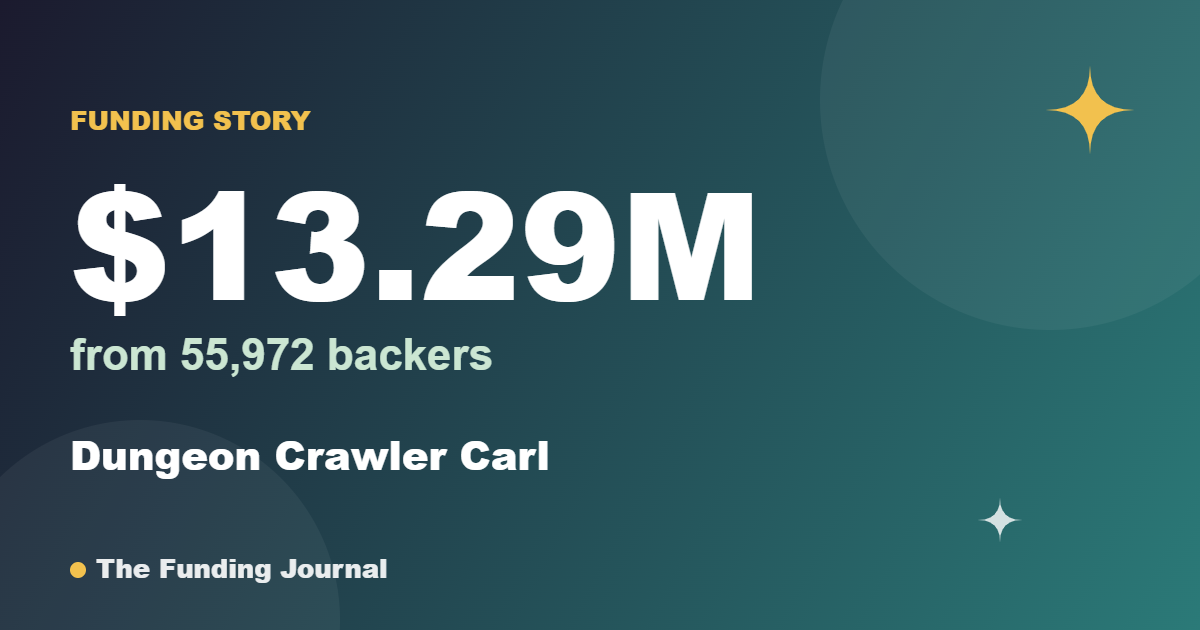
- Raise: Reward crowdfunding on BackerKit: more than $13.29 million from 55,972 backers, against an initial goal of $250,000
- Year: 2026 (launched April 14, closed May 18)
- One-line lesson: A ready-made fan base plus a licensed product can pre-fund production before the first copy exists
What happened
On April 14, 2026, Renegade Game Studios launched one campaign on BackerKit for two products: the Dungeon Crawler Carl Roleplaying Game and Dungeon Crawler Carl: Unstoppable, a solo and cooperative card game. Both are licensed adaptations of Matt Dinniman’s bestselling book series.
The publisher’s closing announcement says the campaign passed $1 million in 19 minutes, raised more than $4.57 million in the first 24 hours and ended at more than $13.29 million from 55,972 backers, after nearly four days in BackerKit’s “Overtime” mode. The publisher calls it the most funded game campaign in BackerKit history. GosuGamers reported the initial goal was only $250,000.
The numbers, in context
- Final total: over $13.29 million, roughly 53 times the $250,000 goal.
- Average pledge: about $237 per backer (our calculation from the publisher’s totals), which points to large bundles and add-ons, not only single copies.
- Speed: $1 million in 19 minutes means the audience was waiting before launch day.
Why it worked
- An existing audience. The books already had a large readership, so the campaign started with demand and did not need to create it.
- A licensed, familiar world. Backers knew what they were buying into.
- Two products in one campaign. An RPG and a card game gave different kinds of fans a reason to back, and encouraged bigger bundles.
- A platform built for this. The campaign ran on BackerKit, a platform focused on tabletop games and pledge management, and not on Kickstarter.
The risk side
Reward crowdfunding is a pre-order, not an investment. Backers receive products if and when they are made, and large physical campaigns carry production and shipping risk. A record raise makes fulfilment harder, not easier, because the publisher now owes tens of thousands of orders. Anyone backing a campaign should read the delivery estimates and the creator’s track record.
What founders can learn
- Build the audience before you build the campaign, and measure it by email subscribers and followers, not likes.
- Offer a clear core product and a menu of add-ons so average order value can grow.
- Set a modest goal you can certainly hit, then plan for the demand that follows. A low goal builds early momentum.
- Budget for fulfilment at the scale of your best case, not your base case.
Sources
- Renegade Game Studios: campaign concludes after record-breaking run (May 19, 2026)
- Renegade Game Studios: campaign launch announcement (April 14, 2026)
- GosuGamers: campaign crashes goals a day after launch
This story summarizes public reporting and company statements and is for general information only. It is not investment advice or an endorsement of any company or offering. See our disclaimer. Facts last checked October 22, 2026; campaigns and company situations can change.
Published by The Funding Journal Editorial. Practical, sourced writing on fintech, crowdfunding, investment platforms, SaaS and AI, and the stories of founders who raised capital.