Spicenet Raises $5 Million Series A to Build a Brokerage Network for On-Chain Finance
Funding Story
- Company: Spicenet (Road Town, British Virgin Islands); CEO Matthew McConnell
- Sector: Blockchain infrastructure: a brokerage network for decentralized finance (DeFi)
- Raise: $5 million Series A led by dao5, with Babylon and Astrarizon
- Total funding: $8 million, following a $3 million seed co-led by Hack VC and Magnus Capital
- Announced: October 27, 2026
- One-line lesson: Early crypto-infrastructure rounds fund product launches and liquidity, so the first test is real usage
What happened
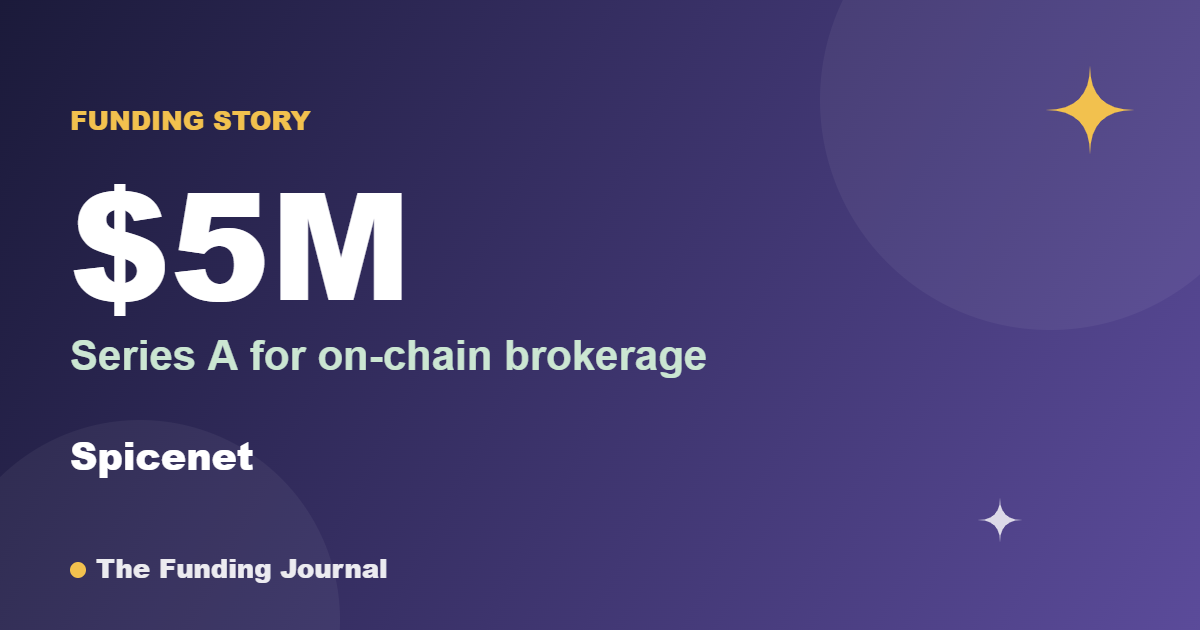
On October 27, 2026, Spicenet announced a $5 million Series A led by dao5, with participation from Babylon and Astrarizon, an ACC Ventures company, according to the company’s Business Wire release. The round follows a $3 million seed co-led by Hack VC and Magnus Capital and brings total funding to $8 million. Spicenet says it is building the brokerage network for on-chain finance.
What Spicenet is building
- A brokerage network. Spicenet connects DeFi applications with users and liquidity across blockchains, so traders can reach different markets without managing separate transactions on each chain, according to CityBiz.
- Spice Flow, a cross-chain product that has recorded more than $160,000 in beta transaction volume, according to TokenPost.
- Spice Edge, a cross-venue margin product nearing beta, with Derive as its first partner.
- Spice Stocks, a consumer app in development that is designed to let users buy tokenised equities with assets from other chains and borrow USDC against eligible holdings. Trading is powered by Aerodrome and borrowing by Aave.
- Its own network. A Celestia-powered Layer 1 handles settlement and accounting and has supported more than 85,000 mainnet transactions, according to FinSMEs.
What the money is for
- Launching Spice Edge and the SPICE token.
- Providing initial liquidity for products on its network.
- Working with BlockSight on transaction monitoring, risk management and security safeguards, according to CityBiz.
How to read the numbers
Spicenet’s own figures show an early-stage product. A beta volume of $160,000 is small, and more than 85,000 mainnet transactions describes activity, not value. A $5 million round gives the company runway to launch, but whether people use its products at scale is the question the next year will answer.
Context: tokenised equities
Spicenet is one of several companies working on tokenised shares. Yesterday also saw Mochatrade, a New York company offering Indian retail investors leveraged access to tokenised US equities, close a $6 million seed round, as we noted in our Wealthsimple report. Tokenised shares raise regulatory questions about who may offer and buy them, and in which countries, and the rules are still being written.
For the private-asset side of the story, see what tokenization means for private assets.
Risks to keep in mind
- Product risk. Key products, including Spice Edge, Spice Stocks and the SPICE token, are not yet fully launched.
- Smart-contract and bridge risk. Cross-chain systems have been targets of hacks.
- Liquidity risk. Thin markets can lead to poor prices.
- Regulatory risk. Tokenised equities and token launches may be restricted in some countries.
- Token risk. A token’s price can fall sharply, and a funding round does not guarantee a token’s value.
What we do not know
- The token’s design, supply and launch date.
- Spicenet’s valuation, which was not disclosed.
- How many users the products have beyond beta testers.
- Which jurisdictions Spice Stocks will serve.
What founders can learn
- Show usage early, even if small. Investors can compare beta volume with the plan.
- Name your partners and safeguards. Naming BlockSight signals attention to security.
- Raise for specific launches. Tie the money to products and liquidity.
- Be clear about regulation when you touch securities or tokenised assets.
Frequently asked questions
What is an on-chain brokerage?
A service that routes trades across blockchains and trading venues so users deal with one interface instead of several.
Is the SPICE token on sale?
The coverage says the token is planned. We have no information on a sale, so treat any offer carefully.
How an on-chain brokerage works, in plain English
- A trader holds assets on one blockchain but wants to use a trading or lending venue on another.
- Normally they would move the assets across with a bridge, swap them and manage separate transactions on each chain.
- A brokerage network aims to route the trade and handle the settlement and accounting behind one interface.
- The trader sees a single action, while the network does the cross-chain steps.
Every extra step is a place where something can go wrong, which is why security and monitoring matter. Spicenet’s partnership with BlockSight on transaction monitoring and risk management addresses that concern, though it does not remove it.
What tokenised equities are, and are not
- They are digital tokens that track the price of a share. How closely they do so depends on how they are issued and backed.
- They may not carry shareholder rights. Voting and dividend rights vary by product.
- Their legal status differs by country. The rules on who can offer and buy them are still being written.
- Borrowing against them adds risk. Spice Stocks is designed to let users borrow USDC against eligible holdings. If the collateral falls in value, a position can be liquidated, which means sold automatically to repay the loan.
A checklist before using any DeFi or tokenised-asset product
- Who holds your assets, and can they be frozen or lost?
- Has the code been independently audited, and when?
- How deep is the liquidity? Thin markets can mean poor prices.
- What are all the fees, including network fees?
- Is it available and legal in your country?
- Do you understand the liquidation rules if you borrow?
- Try a small amount first, and never use money you cannot afford to lose.
The round in context
A $5 million Series A is modest next to the larger rounds announced the same day, such as Hyphenate’s $45 million and Hex’s $100 million. Early crypto-infrastructure rounds typically fund a launch and initial liquidity, which matches what Spicenet says it will do. The next milestones to watch are the Spice Edge beta, the SPICE token launch and whether usage grows beyond testers.
More funding news from October 27
- Wealthsimple Raises up to CA$425 Million at a CA$13.8 Billion Valuation
- Hyphenate raises $45 million for AI finance agents
- Hex raises $100 million at a $1.2 billion valuation
- General Compute raises $100 million at $800 million
Sources and further reading
- Spicenet press release via Business Wire (October 27, 2026)
- TokenPost: Spicenet raises $5 million in dao5-led Series A
- FinSMEs: Spicenet raises $5M in Series A funding
- CityBiz: Spicenet raises $5 million Series A
- Spicenet on X: Series A announcement
This story summarizes public reporting and company statements and is for general information only. It is not investment advice or an endorsement of any company, token or product. Digital assets and decentralized finance carry high risk, including loss of funds. See our disclaimer. Facts last checked October 28, 2026.
Published by The Funding Journal Editorial. Practical, sourced writing on fintech, crowdfunding, investment platforms, SaaS and AI, and the stories of founders who raised capital.