General Compute Raises $100 Million at $800 Million, Betting on Non-Nvidia Chips and Debt-Funded Hardware
Funding Story
- Company: General Compute (United States), founded in 2025; CEO and co-founder Finn Puklowski, CTO and co-founder Jason Goodison
- Sector: AI infrastructure: an inference cloud built on chips from Nvidia’s rivals
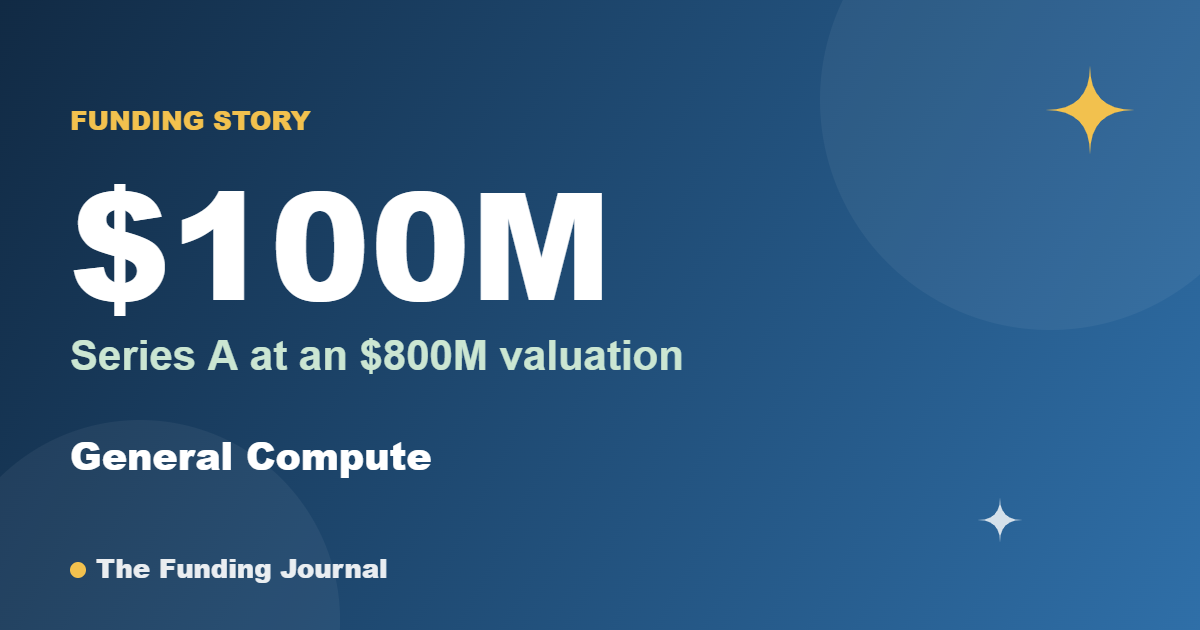
- Raise: $100 million Series A co-led by Blackbird Ventures and Abstract Ventures
- Valuation: $800 million post-money, up from $60 million after a May seed round
- Announced: October 27, 2026
- One-line lesson: A single large customer contract can unlock both equity and asset-backed debt, and it also concentrates risk
What happened
On October 27, 2026, General Compute announced a $100 million Series A co-led by Blackbird Ventures and Abstract Ventures. TechCrunch reports the valuation is $800 million post-money, compared with $60 million after the company’s May seed round of $15 million. Fuse Venture Partners, Village Global and others also participated, according to Wowtale. TechCrunch says a customer deal worth $100 million in annual recurring revenue paved the way for the raise. The customer has not been named.
The numbers
| Item | Figure | Note |
|---|---|---|
| Series A | $100 million | Co-led by Blackbird and Abstract |
| Valuation | $800 million post-money | Up from $60 million after the May seed |
| Seed round | $15 million (May 2026) | Reported by KuCoin and others |
| Anchor customer contract | $100 million in annual recurring revenue | Customer not named |
| Chip financing | Up to $400 million | A debt facility from Upper90, according to Wowtale; TechCrunch calls it the first debt financing of inference chips |
What General Compute does
- It builds an inference cloud on alternative chips. Instead of Nvidia GPUs, it uses specialised inference chips from SambaNova, Positron and Cerebras.
- It sells bare metal. TechCrunch says it supplies servers without an added software layer to cloud companies that offer developers fast inference.
- It handles the hard physical work. Wowtale reports it finances, deploys and operates the chips in colocation space, covering cooling, networking and energy.
- It reuses existing sites. According to NewsBytes, the company reuses old bitcoin-mining sites and aims for 75 megawatts of computing power by 2027.
The finance angle: debt secured on chips
The most interesting part for a funding publication is how the hardware is paid for. Neocloud companies often borrow against the equipment they buy. Wowtale notes that General Compute carries similar leverage to GPU-based rivals, but the loan is secured on inference chips, not GPUs. That is a new type of collateral. Lenders will want to know how quickly such chips lose value and how reliably the customer pays.
Why the timing is notable
Wowtale reports that Gartner warned this month that 80% of neoclouds could disappear by 2030, and that CoreWeave shares and bond prices fell. The worry is less about demand than about debt. General Compute’s answer is that its focus on inference and its anchor contract make it different. CEO Finn Puklowski called the doubts about the sector “massively overstated”, according to AI Weekly.
What we do not know
- The anchor customer, the contract term and whether it will renew.
- When the first deployments go live. Wowtale says the company has not yet launched and expects first deployments next year.
- How the chips’ resale value is treated by lenders.
- How it competes with larger cloud providers as demand grows.
What founders can learn
- Contracts create credibility. A large signed customer helped the company raise equity and equipment debt.
- Match funding to the asset. Equipment loans suit hardware, and equity suits team and software.
- Name the concentration risk. Investors will ask what happens if the anchor customer leaves.
- Pick a niche the giants are ignoring, but show why it will still matter in two years.
Frequently asked questions
What is a neocloud?
A cloud company that rents specialised computing power, mainly for AI, and often borrows heavily to buy the hardware.
What is inference?
Running a trained AI model to produce answers, as opposed to training it. Demand for inference grows as AI products reach more users.
Is the $400 million equity?
No. It is a debt facility to buy chips, separate from the $100 million Series A.
How equipment-backed debt works, and why chips are different
A lender that finances equipment advances money to buy it and takes the equipment, and often the contracts it earns from, as security. Whether the loan is safe depends on a few things:
- How long the equipment is useful. If a chip becomes outdated in a few years, the loan must be repaid faster.
- What it could be sold for. A deep second-hand market makes the collateral safer. For inference chips, that market is new and thin.
- Who pays for its use. A long contract with a strong customer supports repayment.
- Supply and delivery. Chips that are not delivered cannot earn money.
General Compute’s debt is secured on inference chips, according to Wowtale, which is a different kind of collateral from the GPUs behind most neocloud loans.
A rough illustration
This is arithmetic using the reported figures, not a statement about the company’s accounts. A facility of up to $400 million set against a customer contract worth $100 million in annual recurring revenue would imply a simple payback of about four years before power, site costs, interest and other expenses. The chip purchases may also serve more than one customer. The point is to show why contract length and chip life matter so much to lenders.
The main risks
| Risk | Why it matters |
|---|---|
| Customer concentration | The raise was unlocked by one large contract, so losing it would hurt |
| Technology change | Faster chips from rivals could make today’s hardware less valuable |
| Delivery and supply | The business depends on suppliers shipping chips on time |
| Debt service | Repayments continue whether or not demand is strong |
| Power and sites | Reusing old mining sites cuts cost but depends on power access |
| Not yet live | The company expects first deployments next year, according to Wowtale |
The demand case
The company points to rising demand for inference. According to Wowtale, it cites Goldman Sachs projecting a 24-fold rise in inference demand by 2030 and says Google’s token demand grew 330-fold between 2024 and 2026. These are the company’s citations, and we have not independently verified them. Gartner’s warning, also reported by Wowtale, that 80% of neoclouds could disappear by 2030 shows why investors are divided.
For more funding news from the same day, see Hyphenate and Hex.
More funding news from October 27
- Wealthsimple Raises up to CA$425 Million at a CA$13.8 Billion Valuation
- Hyphenate raises $45 million for AI finance agents
- Hex raises $100 million at a $1.2 billion valuation
Sources and further reading
- TechCrunch: General Compute raises $100 million Series A
- Wowtale: Neocloud General Compute raises $100M Series A
- AI Weekly: General Compute raises $100M Series A at $800M
- CityBiz: General Compute raises $100M Series A
- NewsBytes: General Compute raises $100 million Series A
This story summarizes public reporting and company statements and is for general information only. It is not investment advice or an endorsement of any company or offering. See our disclaimer. Facts last checked October 28, 2026; company figures and terms change. Amounts are in US dollars unless stated.
Published by The Funding Journal Editorial. Practical, sourced writing on fintech, crowdfunding, investment platforms, SaaS and AI, and the stories of founders who raised capital.