Robo-Advisers vs Human Advisers: Fees, Features and Trade-Offs
Comparison
- Topic: How robo-advisers and human advisers differ in cost, service and suitability
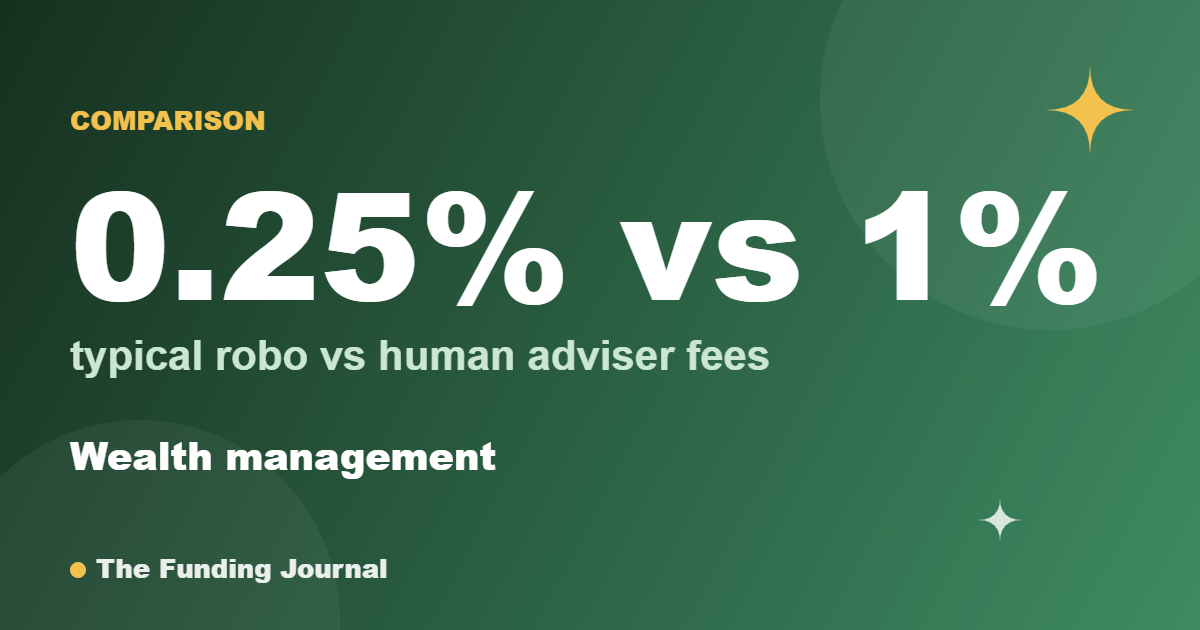
- Typical fees: Robo-advisers commonly charge about 0.25% to 0.50% of assets a year, while human advisers often charge around 1%
- Example: On $100,000, 0.25% is $250 a year and 1% is $1,000 a year, before fund costs
- Takeaway: Pay for the help you will actually use: automation for simple needs, a person for complex ones
Investors who want help managing money now have two broad choices: an automated robo-adviser or a human adviser, with hybrid services in between. They differ in price, personal attention and the problems they solve. This comparison sets out typical fees, a long-term cost illustration and how to decide.
What each one does
| Robo-adviser | Human adviser | |
|---|---|---|
| Core service | Automated portfolio building, rebalancing and goal tracking | Personalised planning, investment advice and ongoing guidance |
| Typical fee | About 0.25% to 0.50% of assets a year | Often around 1% of assets a year; ranges from 0.5% to 2% |
| Minimum | Low or none | Often higher; some start at $250,000 or more |
| Access | 24/7 app or website | Scheduled meetings and calls |
| Best for | Straightforward investing, smaller balances, hands-off savers | Complex finances, such as tax, estate, business sale or retirement income planning |
The fee ranges come from consumer-finance comparisons by NerdWallet, Chime and InvestorMint. Individual providers vary, and fund expenses are charged on top.
What fees look like over 20 years
The figures below are an illustration only. They assume a $100,000 start, a 6% yearly return before fees, fees deducted each year, and no extra deposits, taxes or fund costs.
| Fee level | Net yearly return | Value after 20 years |
|---|---|---|
| 0.25% (robo-adviser) | 5.75% | About $306,000 |
| 1.00% (human adviser) | 5.00% | About $265,000 |
The gap is roughly $40,000. The point is not that one is better, but that a fee charged every year on a growing balance has a large effect, so it should buy something you value.
When a robo-adviser fits
- Your needs are simple: build a diversified portfolio, rebalance it and add money regularly.
- Your balance is modest, or you want low or no minimums.
- You are comfortable making financial decisions yourself.
- You want to limit fees.
When a human adviser fits
- You face a complicated situation, such as selling a business, inheriting assets or planning retirement income.
- You need tax and estate planning alongside investing.
- You tend to react emotionally to markets and want someone to talk you through decisions.
- Your balance is large enough that a personalised service is worth the fee.
Hybrid options
Some providers combine automated investing with occasional access to human advisers, often at a fee between the two. Others charge a flat or hourly fee for planning without managing your money. Compare what is included before you sign.
Questions to ask any adviser
- Are you a fiduciary, and will you say so in writing?
- What are all the fees, including fund expenses and account charges?
- How are you paid? Do you earn commissions on products you recommend?
- What happens to my money if your firm fails?
- How will you handle my situation, such as taxes or a concentrated holding?
- How do I leave, and what does it cost?
A fee checklist
| Cost | What to ask |
|---|---|
| Advisory or management fee | Is it a percentage of assets, a flat fee or a subscription? |
| Fund expenses | What are the expense ratios of the funds you will be invested in? They are charged on top |
| Account and transfer fees | Are there charges to open, maintain or move your account? |
| Planning fees | Is financial planning included or billed separately? |
| Commissions | Does the adviser earn money from products they recommend? |
| Minimums | What balance is needed to get the service? |
Illustrative annual cost at different balances
| Account balance | Robo-adviser at 0.25% | Human adviser at 1% |
|---|---|---|
| $25,000 | $62.50 | $250 |
| $100,000 | $250 | $1,000 |
| $500,000 | $1,250 | $5,000 |
These figures show only the advisory fee. Fund expenses and other charges come on top.
How to decide, step by step
- Write down what you need help with: investing only, or also tax, retirement income, estate planning or business sale.
- Add up your balance and your time. A small balance may not justify a full-service fee, and a busy schedule may favour automation.
- Check how you behave in a downturn. If you would be tempted to sell at the worst time, a person who coaches you may be worth the cost.
- Compare total costs, including fund expenses.
- Check regulation and conflicts of interest for each provider.
- Review yearly. Your needs and your balance will change.
The limits of robo-advisers
- They usually offer limited personal planning beyond investing.
- Their models rest on assumptions about risk tolerance that may not fit your situation.
- Automation does not remove market risk: your portfolio can still lose value.
- Standard portfolios may not consider a concentrated holding, a business or a complicated tax position.
- Customer support may be limited to chat or email.
What a hybrid service offers
Some firms combine an automated portfolio with scheduled access to a human adviser. Pricing sits between the two models, and the value depends on how often you will actually use the human help. Ask for the number of sessions, who the adviser is and how quickly you can reach them.
Frequently asked questions
Is a robo-adviser safe?
A robo-adviser is a regulated investment service in many countries, but regulation does not guarantee returns. Check the provider’s registration, how your assets are held and what protections apply where you live.
What does “fiduciary” mean?
A fiduciary has a duty to act in the client’s best interest. Ask any adviser in writing whether they act as a fiduciary at all times, including when recommending products.
Can I use both?
Yes. Many people use a robo-adviser for core investing and pay a planner by the hour for specific questions, such as a retirement plan or a business sale.
Is the cheapest option always the best?
No. The right choice depends on what you need. The cheapest service is poor value if it leaves a major need unmet, and the most expensive is poor value if you only need an automated portfolio.
The Funding Journal view
The fee gap is real, but so is the gap in what each service does. A robo-adviser is excellent value for investors who mainly need low-cost discipline. A human adviser earns the fee when the problem is more than a portfolio. Many people will use both at different stages, starting automated and adding human help when their finances become more complex.
Sources and further reading
- NerdWallet: Robo-advisors vs financial advisors
- Nasdaq: Financial advisor fees and costs
- Chime: Robo-advisors vs financial advisors
- InvestorMint: Financial advice costs in 2026
This article is general information, not financial, legal or tax advice. See our disclaimer. Facts last checked October 26, 2026; rules, prices and companies change, so confirm current terms before you act.
Published by The Funding Journal Editorial. Practical, sourced writing on fintech, crowdfunding, investment platforms, SaaS and AI, and the stories of founders who raised capital.